Pages

Tuesday, May 8, 2012

Lady Luck!

In many countries in the world, the ladybug is considered a symbol of good luck and some cultures even rear them as pets. The most likely explanation that ladybugs are lucky is because of their huge appetite for crop pests, like aphids, mites, and white flies. Farmers and gardeners welcome the presence of ladybugs and venerate the insect as a lucky symbol. They also say that if a ladybug lands on your hand on a Sunday, and stays there until you count to 22, then good luck is on its way.

One of our Gateway families was kind enough to donate over 1500 Ladybugs for our CMLC garden to help rid of garden pests! The Kindergarten class released them into the garden a couple weeks ago, hoping that the lucky ladies will fill up on garden goodies, lay eggs to create another generation for our garden, and make our gardens filled with beauty and luck! Thank you for the awesome contribution to our garden!

Over 1500 in this bag! 

Preparing the garden for the lady bugs with nice wet soil. 


The release!

Happy at home.

Monday, May 7, 2012

A Closer Look at Infant and Toddler Playtime:


A Closer Look at Infant and Toddler Playtime:

Independent Play/Floor Time includes activities like…
  • Building with blocks
    • exercises fine motor skills, builds concepts like balance and stability, aids color differentiation and counting abilities.
  • Playing with toy animals
    • helps cement animal sounds, encourages dramatic play and imagination.
  • Climbing on large blocks
    • exercises large motor skills and builds concepts of balance, gravity, height, and perspective.
  • Playing with balls
    • Picasso Class Circle Time
    • exercises large motor skills, hand-eye coordination, cooperative skills, and interactive play.
  • Exploring the sensory boat
    • exercises fine motor skills and concepts of force and cause-and-effect.
  • Playing with puppets, babies, and stuffed toys
    • which encourages self-soothing, dramatic and imaginative play, care-giving, and concept of gentle hands.
  • Looking at books
    • encourages fine motor skills, early literacy skills, and observation skills.
  • Playing with vehicles
    • exercises fine motor skills, large motor skills, color and shape identification, and dramatic/imaginative play.
  • Using musical instruments
    • instills beginning math skills of rhythm and patterns, exercises fine motor skills and dramatic play, encourages self-expression

Art activities…
    Water Touch Tub Time
  • exercise fine motor skills, color and texture differentiation, and decision making.

Touch Tubs/Play Dough…
  • aid texture differentiation, self-soothing, fine motor skills, cooperation, and cause-and-effect.

Circle time (singing and reading)…
  • aids early literacy skills, counting, alphabet, rhythm, memory, decision making, cooperation, listening and responding.

All activities encourage sharing, parallel and/or cooperative play, and vocabulary development. 

~ T. Marissa


Getting our hands messy with some finger paint
Looking at a book about trains


Tuesday, May 1, 2012

Reuse and Recycle Summer Program & Garage Sale!


Help Creative Minds ReUse and ReCycle!


Creative Minds Learning Centers are replacing equipment and toys this summer with newer, Eco friendly and Quality items. What to do with our lovingly used equipment and to help raise funds for the new items? Why not have a Summer Community Garage Sale! We would love donations from families to help this be a success!  We will be working with a local homeless shelter to donate clothing and items not sold in the sale. Please save items and let your school's Director know if you would like to help! The date is scheduled for July 28th!
Recycling is so much fun! Now that Spring cleaning is being tackled, you may notice items lying around not being used. Rather than throw it away, ask yourself if this is something that could enhance your child's school? Some of these items could be:
  • Seeds
  • Used Halloween or dress up costumes (non violent)
  • Gently used children's books
  • Toilet or paper towel cardboard tubes
  • Egg cartons
  • Empty cereal and boxes (to be used for dramatic play kitchens & art projects)
  • Paper
  • Ribbon
  • Yarn
  • empty Yogurt containers
  • clean Mason jars
  • Buttons (age 3 +)
  • Plastic bottle caps for counting, sensory and art projects (age 3 +)
If you have questions on what you can or can not donate, please see your school's Director.

Here's a fun craft to use up those toilet rolls and create works of art:


Friday, April 27, 2012

The Very Hungry Caterpillar


With spring finally here the Sellwood Preschool Class took a deeper look at one of our favorite stories, The Hungry Caterpillar. After reading the story, the children munched on a few of the snacks that the Hungry Caterpillar ate on his journey to becoming a butterfly! They even punched holes through the food to represent how the caterpillar ate his food! How fun!


Monday, April 23, 2012

Artistic Expression at Gateway

The Gateway Kindergarten class has been studying a new artist each week in order to explore different medias, forms/styles of art, and challenging themselves to try something new! Many believe there are numerous benefits associated with children learning art at a young age.  Here are 20 reasons to support artistic expression in your child (taken from http://www.artsz.org/20-reasons-why-art-is-important-for-children/). 

  1. Art stimulates both sides of the brain.
  2. 33% of kids are visual learners.
  3. There are studies that show that kids, who make art, read better and get better grades in science and mathematics.
  4. The kids learn by using their senses and art is ideal in this process
  5. The kids need a place to express themselves at school.
  6. Art promotes self esteem
  7. Art encourages kids to give more attention to the physical space that surround them.
  8. Art develops hand and eye coordination.
  9. Art stimulates perception.
  10. Art teaches them to think openly. It represents a culture of questioners more than a culture of responders.
  11. Art teaches that there is more than one solution for a problem.
  12. Art teaches kids to think creatively to solve problems.
  13. Kids can share and reflect on their work of art and learn something about the world they live in.
  14. When art is integrated with the other subjects in the curriculum, kids commit more to the learning process.
  15. In the process of doing art, the child is exposed to different possibilities, to discover and to freedom, this way they avoid falling into the control and the predictability of the conventional education in the United States of today.
  16. Art nourishes the human soul. One feels good doing it.
  17. Art brings the cultural resources of the community into the class.
  18. Art involves parents and tutors in the school, inviting them to participate as volunteers in diverse activities.
  19. Art provides a common ground across racial stereotypes, barriers and prejudices.
  20. Art is valuable all by itself.
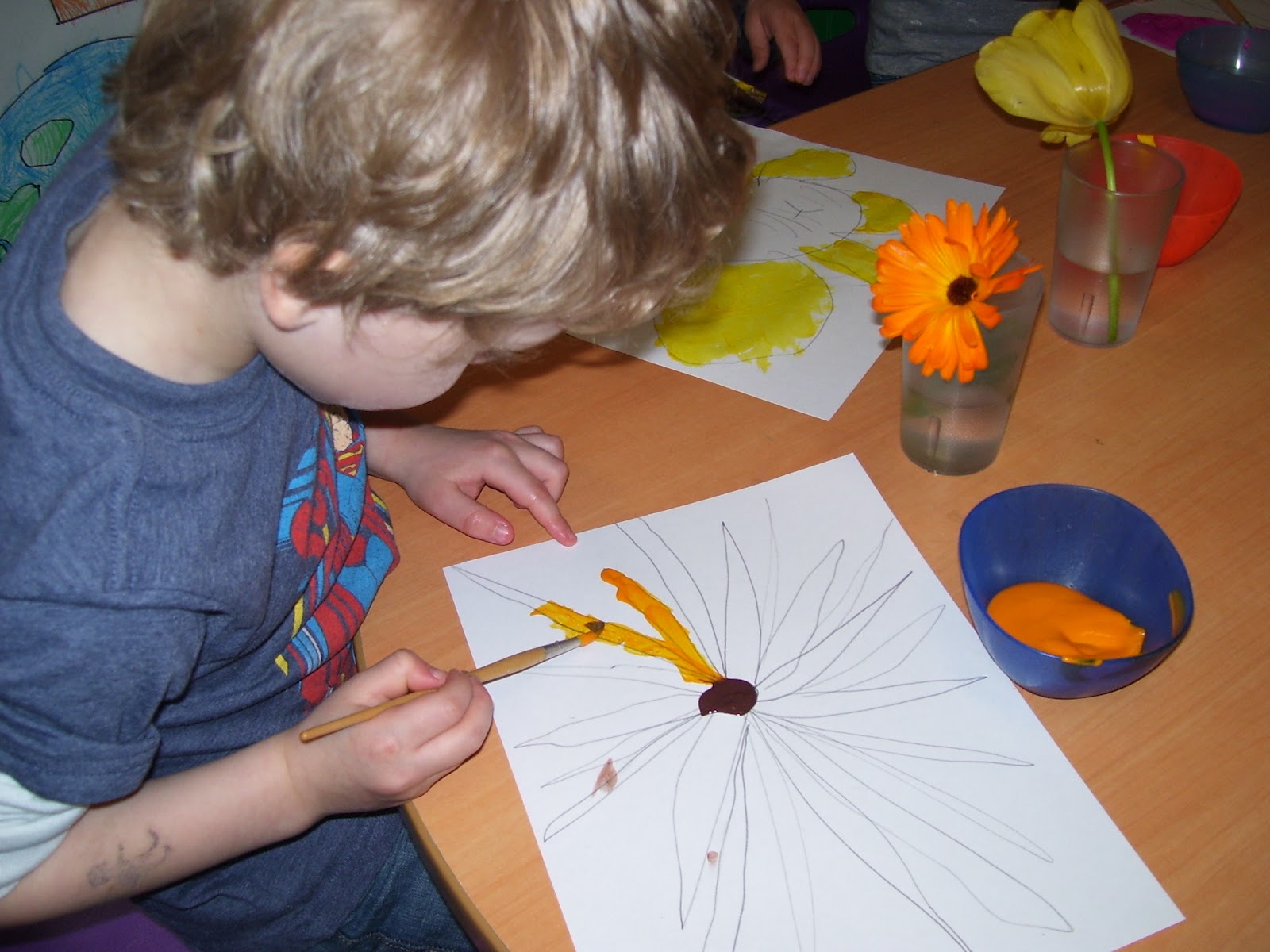
Art inspired by Vincent van Gogh's "Sunflowers" painting.  van Gogh dreamt many of his paintings before they were put onto paper. After the Kindergarteners had some 'dream time' we worked on drawing horizon lines and painting images of our own sunflowers.  

The next week we studied Joan Miro, a Spanish surrealist painter.  We focused on Miro's thick black outlines and overlapping shapes that could be viewed as many different objects, animals, or figures. 

Last week we looked at artwork from Georgia O'Keeffe who was known for her beautiful landscape paintings and larger than life flower portraits.  We took the time to "zoom in" on the real flowers with magnifying glasses so that we could see the many details of one flower.  The kiddos did a great job filling their papers with bright, beautiful, and realistic flowers! 

We will be continuing our artist study for the next few weeks as the children are learning a lot about different artforms, ways to express themselves artistically, feeling proud of their work, and really loving it! 


Earth Day Fun!

The CMLC children celebrated Earth Day on Friday, April 20th! Check out some of the cool projects they created!

The Broadway School children planted flower and vegetable seeds in honor of Earth Day!

 Broadway's Alder Classroom painted a banner with their handprints that says "We Love our Earth"

The Westmoreland School children created Egg Carton Planters and had fun working on Earth Day Puzzles!

Teacher Tara planted seeds in Peet Pots with her Pre K students.

The Sellwood School Kindergarten Class made Earths out of recycled construction paper while discussing small ways in which they can make a difference at home, like turning off lights and being more conscious about water usage while brushing their teeth and taking baths. 

Sellwood's Preschool Sequoia Classroom explored Forest Habitats and created natural material collages! 

The Gateway Preschool Class decorated a bulletin board about 10 ways to help save the Earth.  They chose how they would like to help and wrote the idea on their hand print and added it to the bulletin board! 

The Kindergarten children re-used old milk jugs decorated in fabric to make Sweet Pea Planters.  They are going to take home sweet pea seeds and plant them with their families! 

The Woodstock children planted wild flower seeds during their Earth Day Celebration!

The children at Woodstock explored the Earth with magnifying glasses!

Friday, April 20, 2012

Infant Sign Language is a helpful tool to help our children and teachers communicate during the pre-verbal stage. Some of the most basic and frequently used signs in our CMLC infant classrooms are shown below:


Research shows that children who learn to sign early in life often develop increased vocabularies and more advanced cognitive skills. It also aides in strengthening the bond between child and caregiver.
Here is Mabel telling teachers she is finished painting.